
HVAC Condensate-Riser Access Inside an Owner Closet: What Should Cocoa Beach Condo Buyers Verify?
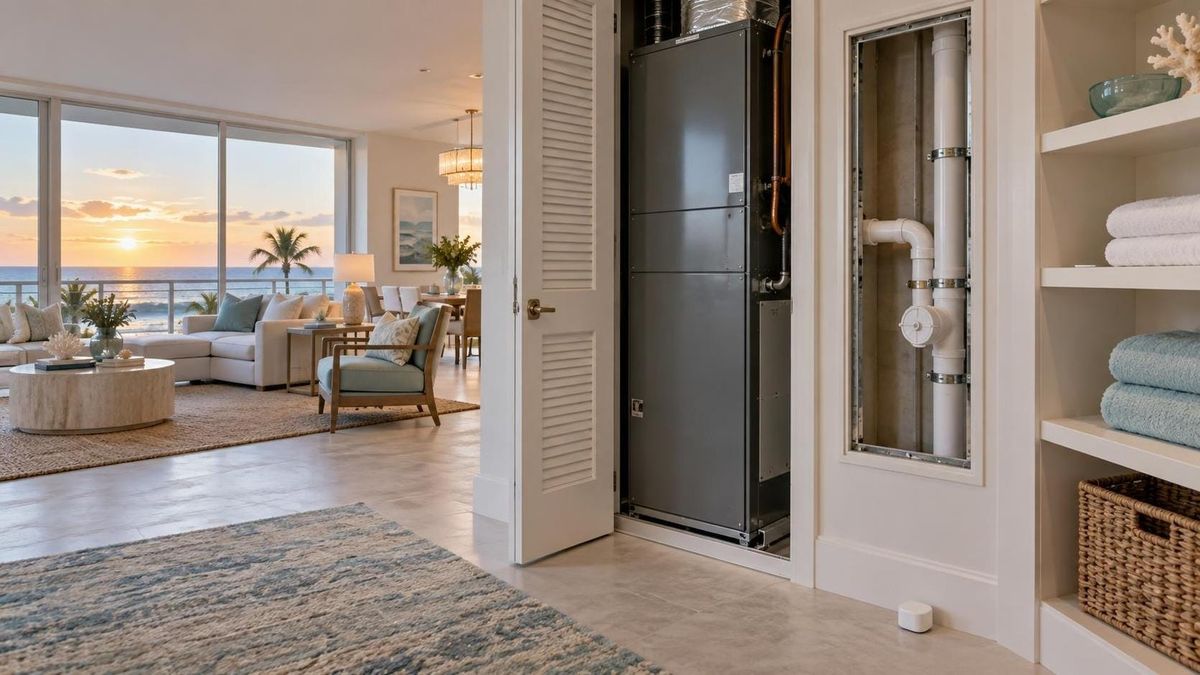
By Carrie Liotta, Space Coast REALTOR® with REAL Broker | Published October 2, 2026 If an HVAC condensate-riser access panel is inside a private Cocoa Beach condo closet, verify the pipe’s purpose, ownership, maintenance history, and entry procedure before buying. The panel is not automatically a defect, but an unidentified shared drain or vague access rule can turn one clogged line into water damage, disrupted storage, and an avoidable cost dispute. I would not judge this setup from the panel alone. I would trace the air handler’s drain, confirm whether the concealed piping serves only the unit or multiple floors, read the declaration and maintenance chart, and ask how the association actually handles routine service and emergencies. The practical question is not simply, “Can someone open the panel?” It is, “Who must do what when water stops moving?” First, identify what is behind the panel Condo listings often use the word riser loosely. A true vertical riser may serve several units. The panel could also conceal a branch connection from one air handler, a cleanout, a trap, a vent, a shutoff for another system, or an abandoned route left from an earlier mechanical layout. A label written on drywall is a useful clue, not proof. Ask a licensed HVAC contractor to begin at the air handler and identify the primary drain, overflow protection, cleanout, direction of flow, and point where unit piping enters a larger route. Compare the observed layout with plans, permits, invoices, and association records. The Florida Mechanical Code’s general-regulations chapter is an official condensate reference, but the contractor and permitting authority must apply the edition governing the actual work. Separate ownership from physical location A pipe inside the painted boundaries of a unit is not automatically the owner’s property, and a common line behind an owner’s closet is not automatically the association’s responsibility for every related expense. Condominium declarations define unit boundaries, common elements, and limited common elements differently. Maintenance charts, amendments, rules, and board resolutions may add operational detail. Florida law provides the framework, not a parcel-specific answer. Under Florida Statutes section 718.113 , common-element maintenance is generally the association’s responsibility, except that a declaration may assign limited-common-element maintenance to the unit owner or allocate its cost in a particular way. That is why I want the buyer to obtain the actual declaration and maintenance chart rather than rely on a seller, property manager, or neighbor saying, “The association takes care of it.” Read the documents for five separate responsibilities: • Who cleans the unit branch, trap, and accessible cleanout? • Who clears, repairs, or replaces the shared riser? • Who opens and closes the wall or access panel? • Who removes closet shelving, stored belongings, or built-in cabinetry? • Who restores drywall, paint, trim, flooring, and damaged personal property? Those answers may not all belong to the same party. A declaration could make the association responsible for a shared pipe while leaving the owner responsible for finishes, access preparation, or damage to personal belongings. If the language is unclear or the potential exposure is material, a Florida condominium attorney should interpret it. A real estate agent, HVAC technician, and property manager can gather facts, but they should not guess at legal responsibility. Confirm how access works in real life Florida Statutes section 718.111 gives an association an irrevocable right of access to a unit during reasonable hours when entry is necessary to maintain, repair, or replace association-maintained property or to prevent damage. The statutory right of access matters, but it does not tell a buyer who holds a key at 10 p.m., how much notice routine maintenance receives, or what happens when a seasonal owner is away. Ask the association or manager to explain the operational procedure in writing. Does the building keep an emergency key under an approved policy? Must the owner provide a local contact? Will maintenance staff enter, or must a licensed contractor be scheduled? Is the closet required to remain clear? Does the association notify owners before annual drain cleaning? Who documents the condition of finishes before opening a wall? A full-time owner may only need to empty a closet. A seasonal owner may need a key holder, remote authorization, and someone to protect stored belongings. Custom cabinetry that blocks working room can turn a small panel visit into a larger project. This is where an apparently private storage feature becomes part of the building’s maintenance system. My guide to roof-drain service access through a private Cocoa Beach condo area explains a related principle: ownership, service rights, physical clearance, and finish restoration should be resolved together. The condensate question is different because the inspection must also trace the air handler, branch drain, shared riser, and recurring moisture history. Look for the history of water, not just today’s dry surface A freshly painted closet can be dry during a showing and still have a recurring problem. Check the panel edge, baseboards, shelf supports, adjacent drywall, flooring, air-handler platform, drain pan, and ceiling below. Stains, swollen trim, rust, mineral residue, odor, growth, or repeated patches deserve an explanation. One normal moisture reading does not erase prior events. The U.S. Environmental Protection Agency’s moisture guidance identifies leaking or condensing pipes in chases and poorly draining air-handler condensate pans as potential moisture problems. EPA recommends repairing leaks promptly and keeping drain pans and drains flowing freely. That is useful context, not proof that a particular stain is mold or that a specific drain is defective. When visible conditions or history justify it, bring in qualified HVAC, water-damage, or indoor-environment professionals rather than diagnosing from a photo. Request at least two or three years of relevant records when available: • HVAC service invoices for the unit, including drain clearing and overflow-switch work. • Association work orders for the riser, chase, or neighboring units on the same stack. • Water-intrusion reports, insurance claims, remediation invoices, and finish repairs. • Minutes or notices mentioning scheduled condensate cleaning, repeated backups, or pipe replacement. • Permits and final inspections for air-handler replacement, rerouting, chase work, or a modified access opening. A single clog years ago that was corrected and documented is different from three summer backups with no identified cause. The pattern matters: which floor first reported water, where the obstruction was found, how the line was cleared, whether the pipe was scoped or replaced, and whether the same section failed again. Test the complete service path during due diligence Coordinate the inspection with the association rather than opening common property without permission. The buyer’s HVAC contractor can evaluate the unit equipment and visible piping; an association contractor may need to handle the shared line or chase. Agree on scope before disturbing panels or finishes. A useful inspection should answer these practical questions: 1. Where does condensate begin and end? Trace the route from the coil and pan to the approved termination or shared connection. 2. What can be serviced without demolition? Identify the cleanout, trap, access panel, working clearance, and any built-in obstruction. 3. What protects the unit from an overflow? Document the pan, switches or other controls, their test results, and who maintains them. 4. What happens upstream and downstream? Ask whether other units connect to the same vertical line and how a blockage location is determined. 5. Do records and conditions agree? Match permits, plans, invoices, association statements, and visible work. Verify the contractor through the Florida DBPR license search . Because existing Cocoa Beach buildings may contain work approved under earlier code editions, evaluate the actual system and permit history rather than comparing it casually with a new installation. Price access risk separately from HVAC age Buyers often blend every air-conditioning concern into one number: the cost of replacing the air handler. That can miss the more complicated exposure. The equipment might be relatively new while the shared riser is poorly documented, the access panel is blocked, or prior water damage has never been fully explained. Conversely, an older unit can still be a manageable purchase when the line is accessible, routinely maintained, and supported by a clear association procedure. Separate the possible costs: unit drain cleaning, overflow-control repair, shelf removal, panel work, finish restoration, shared-riser clearing, investigation, and possible pipe replacement. Get written scopes from professionals who have seen the building, with assumptions about access, responsibility, restoration, and permits. The strongest negotiation request is not always a credit. It may be an association letter confirming maintenance responsibility, a completed service before closing, access to the stack’s work-order history, seller removal of an obstructing built-in, or an inspection contingency that remains open until the correct contractor can see the line. A credit that sounds generous can still leave a buyer with no permission to alter common property. Read the condo documents as part of the mechanical inspection Mechanical facts and association documents must match. Review the declaration, maintenance chart, rules, budget, reserves, minutes, insurance information, and project notices. My guide to the Space Coast condo documents buyers should read explains why the unit and association cannot be evaluated separately. Also compare what the manager says with what is written. If staff says the association clears every riser annually, ask for the schedule, contract, or work orders. If the declaration says the owner maintains everything serving only the unit, confirm where the shared line begins. If several owners have installed cabinets across access panels, ask whether those modifications were approved and who removes them during service. For another example of a private appliance route crossing common building space, read my analysis of a Cocoa Beach condo dryer vent through a common ceiling area . The physical system changes, but the disciplined approach remains useful: map the route, identify boundaries, confirm approvals, allocate maintenance, and understand the real cost of access. My offer-stage checklist for this Cocoa Beach condo • Photograph the air handler, drain components, access panel, closet layout, and every visible stain or repair. • Have a licensed HVAC contractor identify the unit branch, shared connection, cleanout, and overflow protection. • Obtain the declaration, maintenance chart, access rules, and relevant work-order history. • Ask who enters the unit during routine service, an after-hours backup, and an owner’s extended absence. • Confirm who removes storage or cabinetry and who restores finishes afterward. • Match permits, plans, invoices, service records, and the field installation. • Get written scopes for unresolved access, moisture, or drainage conditions before the inspection deadline. • Discuss legal document ambiguity with a Florida condominium attorney and coverage questions with the appropriate insurance professionals. Bottom line An access panel inside a private owner closet does not make a Cocoa Beach condo a bad purchase. An unidentified pipe, recurring water history, blocked service path, or unwritten responsibility can make it a more expensive one. I want the buyer to know what the panel serves, who maintains each section, how entry works, and what happens to the closet after service. If you are comparing Cocoa Beach condos, reach out for a no-pressure conversation about Brevard County homes for sale. I can help you organize the building documents, inspection questions, and association follow-up so the coastal lifestyle does not hide an avoidable maintenance surprise. Join my private Facebook group, Moving to Brevard County Florida , for practical relocation guidance. Your next chapter starts here. Originally published on 321 Coastal Living: https://321coastalliving.com/cocoa-beach-condo-condensate-riser-owner-closet/ Carrie Liotta | REAL Broker | 321 Coastal Living