
EV-Ready Garage or Lower District Assessment: Which Viera Home Is the Better Buy?
Prioritize the EV-ready garage when home charging is essential, the installation is permitted and professionally documented, and the electrical service can support your real driving needs. Choose the lower-assessment home when charging would be simple to add and the annual savings meaningfully impro
Originally published by Carrie Liotta, REAL Broker / 321 Coastal Living. Read the original guide here: https://321coastalliving.com/viera-ev-charger-panel-vs-lower-assessment/.
This Space Coast Living Guide adaptation highlights the buyer strategy from Carrie's original 321 Coastal Living article for readers comparing Brevard County real estate, commute tradeoffs, insurance questions, and neighborhood fit.
EV-Ready Garage or Lower District Assessment: Which Viera Home Is the Better Buy?
By Carrie Liotta, Space Coast REALTOR® with REAL Broker | Published September 18, 2026 on 321 Coastal Living
Prioritize the EV-ready garage when home charging is essential, the installation is permitted and professionally documented, and the electrical service can support your real driving needs. Choose the lower-assessment home when charging would be simple to add and the annual savings meaningfully improve your total payment. Compare both over your expected ownership period.
This is a very Viera-style decision: one home offers newer technology and a smoother daily routine, while another may offer a lower recurring ownership cost. The mistake is treating either the charger or the assessment as a label. An installed box on the wall does not prove useful capacity, and last year's tax bill does not automatically predict your future total payment.
Start with your charging routine, not the equipment brand
Ask how many miles you drive on a normal day, where the car parks overnight, how quickly you need to recover that range, and whether the household may add a second electric vehicle. A buyer with a long employer commute, irregular shifts, or two EVs may value a capable Level 2 setup much more than someone who works remotely and can recover daily mileage slowly.
The U.S. Department of Energy's home EV-charging guidance explains that many drivers charge overnight with Level 1 or Level 2 equipment. It also notes that a Level 1 cord can work when a dedicated branch circuit is available and the driver's daily range needs are modest, while Level 2 can better fit longer commutes, larger batteries, or less regular schedules.
That means the “EV-ready” premium is personal. If ordinary Level 1 charging would cover your use, a costly electrical setup may be nice rather than necessary. If you routinely return home with a depleted battery and leave again early, reliable higher-capacity charging may be part of the house's functional value.
Verify what the garage actually has
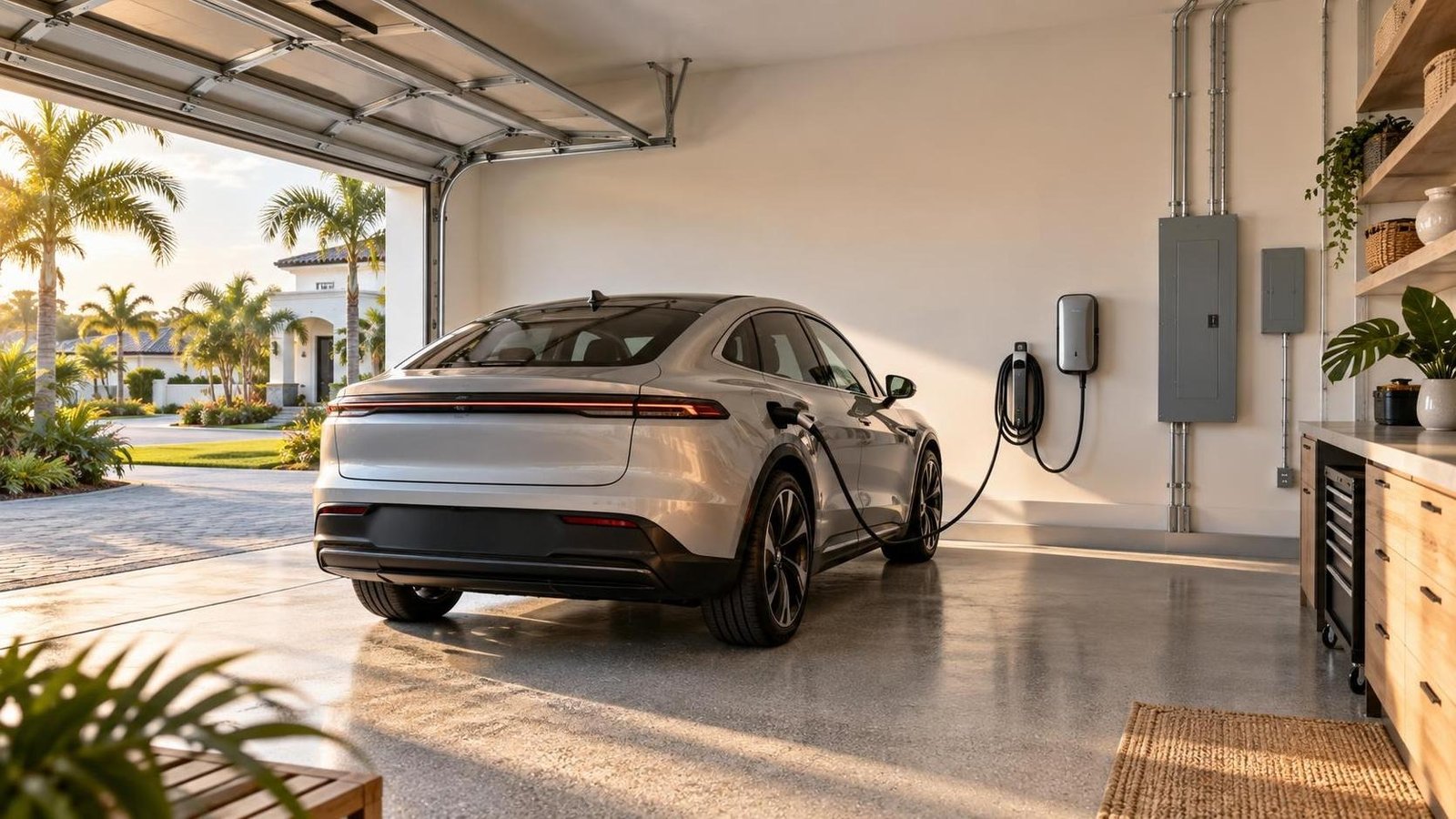
I want buyers to identify the charger model, rated output, circuit size, wiring path, disconnects when applicable, installation date, contractor, permit, final inspection, warranty, and whether the equipment stays with the property. Then I want a licensed electrician to evaluate the service and panel for the buyer's intended load.
DOE advises that electricians can determine whether the home has adequate capacity and that local permits may be required. Its guidance also recommends safety-certified equipment and a qualified electrical contractor. The important point is not to assume that a large panel number or impressive wall unit tells the whole story. Existing HVAC, pool equipment, water heating, solar, battery storage, and other loads all matter.
Look at placement too. Can both parking bays reach the cable without crossing a walkway? Does the vehicle fit with the garage door closed? Is the cord protected from impact and trip hazards? If the charger is outdoors, is the equipment rated for that use? A technically functioning installation can still be inconvenient every evening.
Read the lower assessment on the actual tax bill
Viera buyers hear “CDD,” “district assessment,” “bond,” and “non-ad valorem” used loosely. Do not compare homes from a listing field alone. Obtain the most recent tax bill, current proposed-tax information when available, district documents, and closing estimates. Identify each recurring and debt-related line, who levies it, and whether any amount is scheduled to change or end.
The Florida Department of Revenue explains that non-ad valorem assessments are calculated on a unit basis rather than property value and may support improvements or services such as drainage, lighting, or paving. They often appear on the tax notice or tax bill, but the buyer still needs the property-specific documents to understand the amount and structure.
Do not use the seller's total tax payment as your future tax forecast. Ownership change, exemptions, assessed value, millage, and assessments can affect the buyer's result. Ask the lender and title or tax professionals to build a realistic estimate instead of copying the seller's escrow.
Turn both choices into the same time horizon
A charger is mostly an upfront infrastructure question with possible equipment replacement later. A district assessment is usually a recurring annual question. Put both into a three-, five-, or ten-year view that matches your likely ownership.
For the EV-ready home, include any purchase-price premium, electrical inspection, equipment age, expected charging convenience, and possible future upgrade. For the lower-assessment home, obtain a licensed installation estimate that includes panel work, trenching or wiring distance, drywall repair, permitting, equipment, and any load-management solution. Do not use a generic online charger price if the electrical work is unknown.
Then compare the recurring assessment difference over the same years. This is not a prediction of resale value. It is a way to see whether the convenient garage costs a modest amount, a substantial amount, or very little after installation work and annual carrying costs are placed on the same page.
My recent guide to a two-office Viera home versus a lower-assessment resale with one flex room uses the same principle: recurring costs should be compared with the feature you will actually use.
When the EV-ready garage should win
I give the equipped home more weight when the household drives frequently, needs dependable overnight recovery, and cannot tolerate a long post-closing electrical project. It also deserves credit when the documentation is complete, the panel has been professionally evaluated, the garage layout works, and the home has room for the buyer's future charging plan.
A relocator with an immediate start date may value certainty. If the car is the primary commute vehicle, moving into a house that already supports the routine can remove one project from a crowded first month. That convenience is real, even if it cannot be reduced to equipment cost alone.
The EV-ready home can also be stronger when adding capacity at the alternative property would trigger a larger service or panel project. Only a qualified professional reviewing the exact home should make that determination.
When the lower-assessment home should win
The lower recurring cost deserves more weight when the buyer's charging needs are modest, the garage already has an easy electrical path, and a licensed quote shows that the desired setup is straightforward. It can also be the better choice when the home has a stronger roof, floor plan, lot, commute, or insurance file. Do not let one wall-mounted device outweigh the entire property.
A lower assessment can protect payment flexibility for years. That may matter more to a buyer who expects childcare costs, plans a future renovation, travels frequently, or wants a larger emergency reserve. The best Viera home is not the one with the longest feature list. It is the one whose recurring obligations still feel comfortable after ordinary life changes.
If the equipped home is new construction or nearly new, compare the full builder package rather than one incentive. I addressed a related ownership stack in whether Viera relocators should choose a solar resale with a newer roof or a builder home with higher assessments.
Do not forget HOA approval and parking rules
Inside a private garage, the charger itself may seem invisible to the association, but exterior conduit, a driveway-side unit, shared walls, meter changes, solar integration, or electrical work affecting common property can create an approval question. Review the current declaration, architectural rules, owner responsibility, and any application process.
Townhomes, villas, and condominiums need a different level of care because parking spaces, exterior walls, electrical capacity, and common elements may not be solely controlled by the owner. A seller's existing use does not automatically establish the buyer's right to modify or expand it.
Ask whether the charging equipment is owned, financed, leased, or bundled with another energy agreement. Confirm what transfers. A charger that will be removed before closing should not support the price, while a permanently installed, documented setup should appear clearly in the contract and seller records.
How this affects resale
Electrical readiness can widen appeal as more households consider plug-in vehicles, but buyers will still prioritize location, condition, payment, and floor plan. A clean installation is a supporting feature, not a substitute for a sound house. An unexplained electrical modification can do the opposite by creating inspection and insurance questions.
District assessments also affect resale because future buyers will compare total monthly obligations. A home with a higher assessment may compete successfully when it offers newer infrastructure, useful amenities, and a better daily routine. It simply needs pricing that acknowledges the recurring cost.
Resale is strongest when the next buyer can understand both sides quickly: here is the documented charger and electrical capacity; here is the current tax and assessment file; here is what the HOA covers; and here is the home's condition. Clarity helps more than claiming either feature is universally superior.
My Viera offer checklist for this comparison
- Confirm the charger make, model, rating, ownership, warranty, and inclusion in the sale.
- Review electrical permits and final inspections through the correct jurisdiction.
- Have a qualified electrician assess panel and service capacity for your intended vehicle and household loads.
- Park the vehicle in the actual bay and test cable reach and garage clearance.
- Read HOA or condominium rules for electrical and exterior modifications.
- Obtain the latest tax bill and identify every district or non-ad valorem assessment.
- Estimate the buyer's taxes rather than adopting the seller's current total.
- Get a written quote to add equivalent charging at the lower-assessment home.
- Compare both options across the years you realistically expect to own.
The Brevard County building-permit portal is a starting point for homes in the county's jurisdiction. Always confirm whether the exact property uses county or another permitting authority and whether older records require a separate request.
A practical decision rule
If you need reliable Level 2 charging immediately and the alternative home requires uncertain electrical work, favor the documented EV-ready garage when the rest of the property fits. If charging is easy to add and the assessment difference compounds into meaningful annual savings, favor the lower-cost ownership structure.
When the decision is close, choose the better house: location, floor plan, roof, HVAC, insurance, drainage, and resale. Technology can be added. A poor lot or uncomfortable payment is harder to fix. This is also why I encourage buyers to compare a preserve-view resale with a newer alternative in the context of the complete Viera property, not one feature.
The bottom line
An EV-ready garage is worth prioritizing for buyers whose commute and schedule make home charging essential, but only after permits, capacity, equipment, and garage usability are verified. A lower district assessment is worth prioritizing when charging can be added cleanly and the recurring savings strengthen the budget for years.
I am Carrie Liotta, Space Coast REALTOR® with REAL Broker. Through 321 Coastal Living, I help buyers compare Viera homes by daily function and total ownership cost, not just listing features. Reach out for a no-pressure conversation about buying in Viera. Your next chapter starts here.
For the full source article, local context, and related Brevard County buyer resources, read Carrie Liotta's original 321 Coastal Living guide: https://321coastalliving.com/viera-ev-charger-panel-vs-lower-assessment/.